Palm Leaf Wall Murals for Bright Rooms That Need More Energy
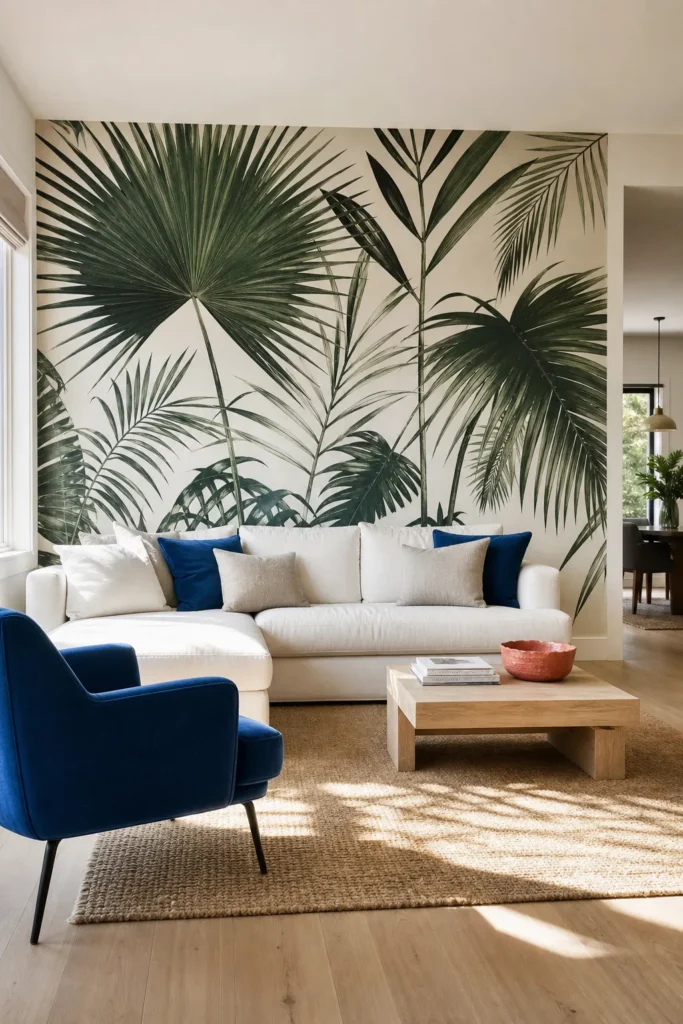
A room can be full of daylight and still feel flat. White walls bounce light, pale floors keep everything airy, and large windows remove darkness—but none of those features automatically give the room a point of view. A palm leaf wall mural works in this situation because it adds something brightness alone cannot: contrast, movement, and a clear place for the eye to land.
The mistake is treating “more energy” as permission to add every tropical color and motif at once. Palm leaves already create rhythm through their radiating lines, curved stems, and overlapping silhouettes. The best rooms use that graphic power deliberately. They choose a palm shape that suits the architecture, test how the green behaves in real sunlight, and repeat only a few colors elsewhere.
Use contrast instead of adding more brightness
If the room is washed in white, cream, or pale gray, another low-contrast surface may preserve the brightness but leave the space feeling unfinished. A green palm mural introduces darker values that sharpen the pale elements already there. White trim looks crisper, blond timber becomes warmer by comparison, and a simple cream sofa gains a stronger silhouette.
Energy comes from the distance between light and dark, not from using the loudest possible green. A mural with forest-green fronds on a soft ivory ground can feel more animated than a neon tropical print because each leaf remains readable. If your window wall is extremely bright, a medium or deep green focal wall can visually hold the room together instead of disappearing in the glare.
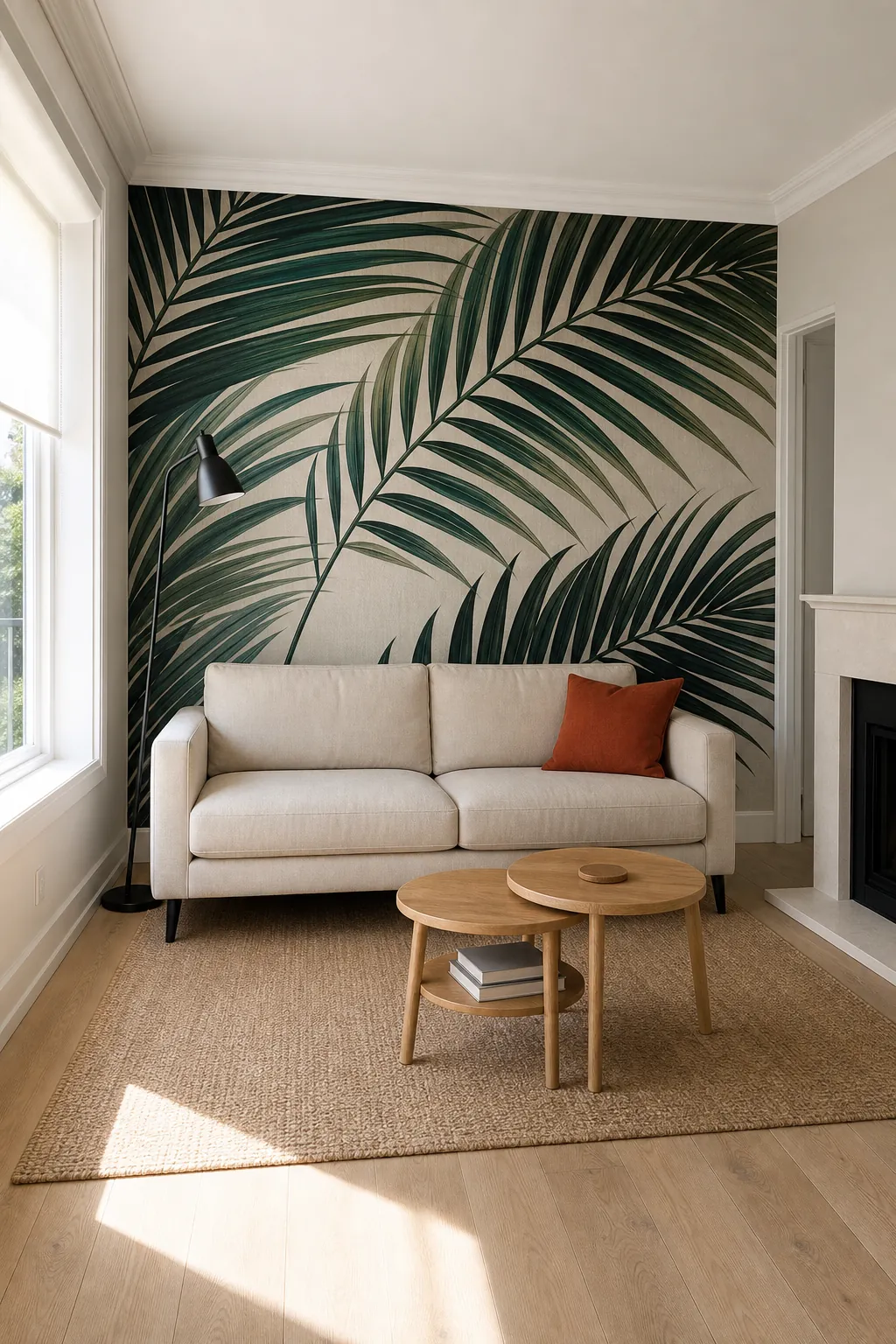

Look around the room before choosing the darkest tone. Black window frames, a dark stone fireplace, or walnut cabinetry can support a deeper mural. If every fixed finish is pale and delicate, choose green with visible tonal variation rather than a near-black background. The goal is a useful visual anchor, not a wall that looks detached from the house.
Match the palm shape to the room’s lines
Not all palm imagery creates the same kind of movement. Fan palms radiate outward and feel bold, circular, and graphic. Feather palms have long arching fronds that guide the eye across a wall. Tall trunks emphasize ceiling height. Cropped leaf close-ups create a denser, more abstract field. Choose by the direction the room needs, not only by which sample looks prettiest.
- For a long blank wall: arching feather palms can carry movement horizontally without adding small repeated marks.
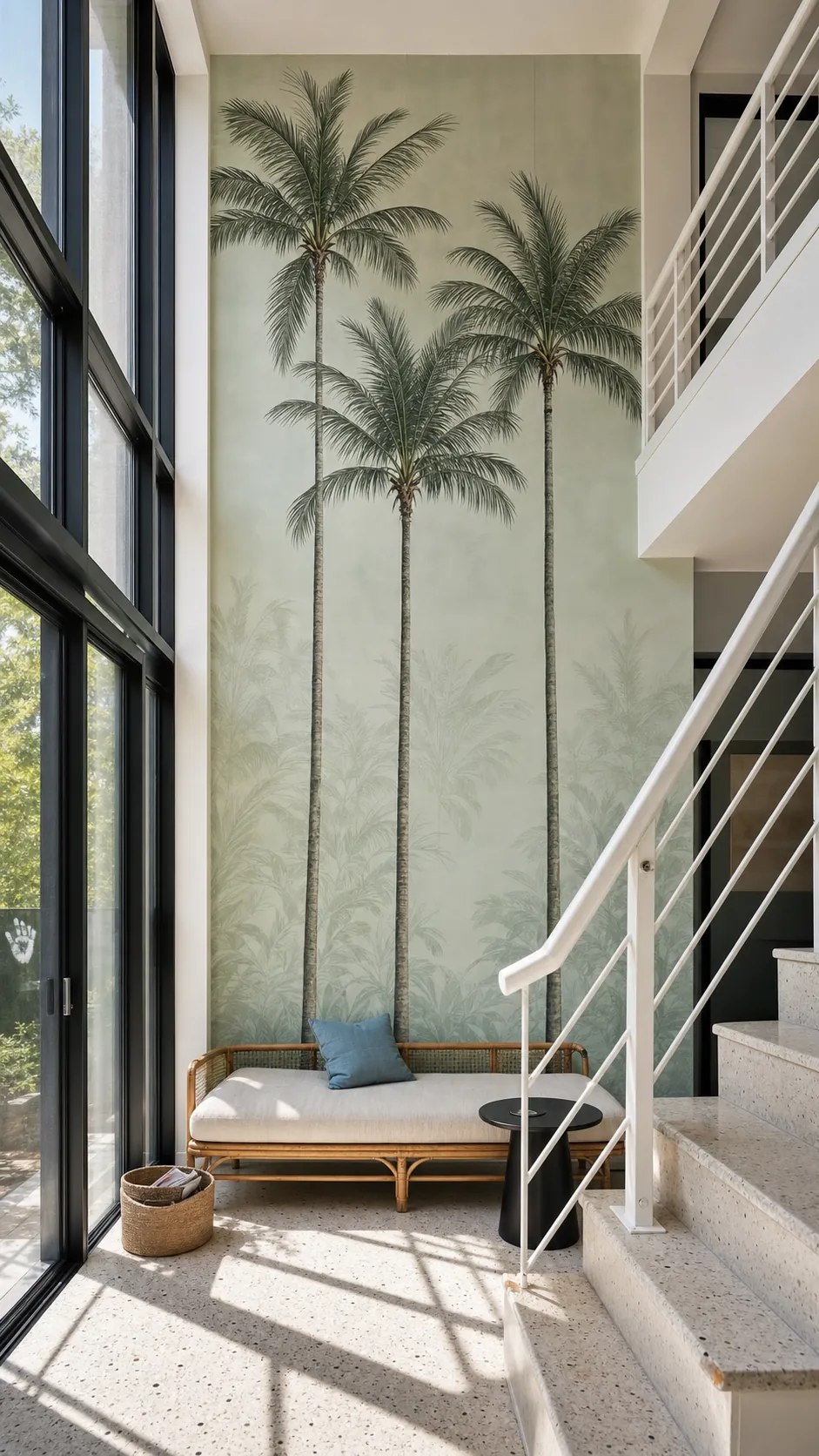
- For a tall stair or double-height zone: visible trunks and high crowns reinforce vertical scale.
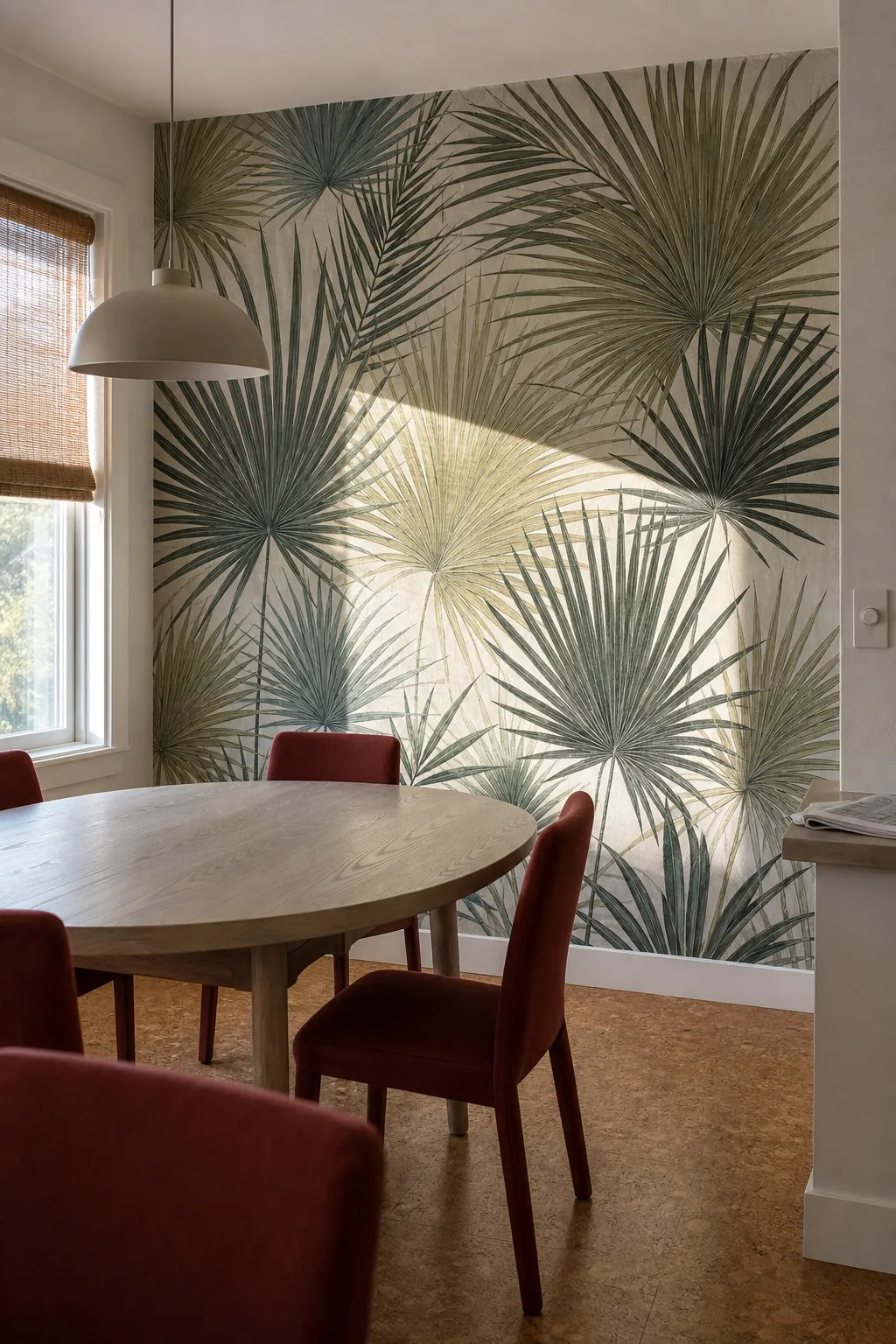
- For a compact breakfast nook: one or two oversized fan leaves can add punch without turning into visual noise.
- For a wide wall behind a low sofa: layered mid-height fronds keep the interesting detail above the furniture line.

View the design from the doorway and from the seat used most often. A small online preview encourages you to study details from inches away, but a mural lives at room scale. If the fronds dissolve into texture from across the space, the repeat may be too fine. If one leaf overwhelms every window, door, and piece of furniture, the crop may be too aggressive. The right scale remains legible without making the architecture feel miniature.
Read the daylight before selecting the green
A bright room changes by the hour. Strong morning sun can make blue-green leaves look fresh and crisp, then a warm late-afternoon exposure can pull out olive or yellow undertones. A mural that appears perfectly balanced on a backlit screen may look much warmer on paper beside honey oak or cream tile.
Order the largest sample available and place it on the intended wall for several days. Check it in direct sun, bright shade, cloudy light, and under your evening bulbs. Do not hold it beside the window and make a decision in thirty seconds. A wall opposite glazing receives very different glare from a wall perpendicular to it, and a slight sheen can exaggerate the difference.

For rooms with intense direct sun, ask the seller about the printed material, recommended exposure, cleanability, and colorfastness. Window treatments can protect the room during the harshest hours while still preserving daylight. A woven shade or solar screen also softens glare so the leaf detail stays visible instead of becoming a reflective patch.
Choose a wall that carries activity
The obvious wall is not always the right one. A mural behind a television may compete with moving images and cables. A wall covered by tall shelving may hide the palm structure. In a bright room that needs energy, choose a surface where the leaves can visually connect the furniture grouping or pull attention toward a useful destination.
A bright room tropical mural can work especially well behind a dining banquette, across the back of a sunroom, at the end of a pale hallway, or behind a low console in an open living area. These placements add momentum to spaces that people pass through or gather around. They also let the mural function as architecture rather than a separate picture hung on top of the room.
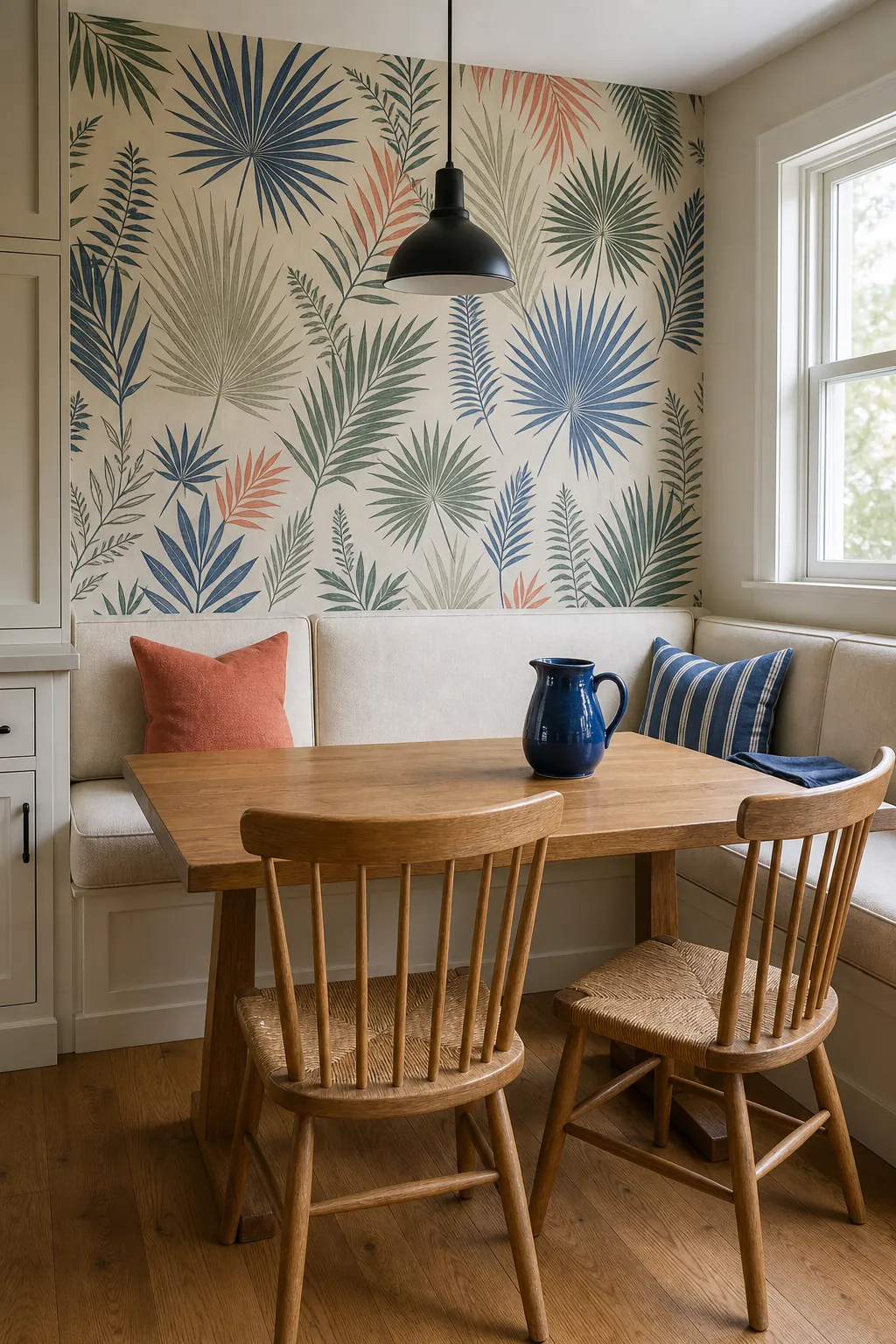

Before ordering, mark the wall dimensions and major furniture heights on a scaled image or proof. Move the crop so the most expressive frond is not sliced by a door, hidden behind a cabinet, or centered directly on a wall sconce. A deliberate crop makes even a vivid palm wallpaper mural feel integrated.
Build a color bridge to what you already own
You do not need to buy an entirely new room. A good mural contains more bridge colors than green: charcoal stems, chalky gaps, warm tan trunks, dusty blue shadows, muted coral details, or creamy highlights. Select one bridge color that relates to a fixed finish and one accent that adds life.
- With warm oak floors, look for olive, tan, or clay inside the print and repeat it in one textile.
- With cool gray tile, use blue-green foliage plus black or charcoal for definition.
- With cream upholstery, choose a mural ground that is warm white rather than stark optical white.
- With colorful furniture, let one existing color reappear in a very small mural detail instead of matching the dominant green.
Repeat the accent twice, not everywhere. A coral thread in the mural might return in a cushion and a ceramic bowl. A dusty blue shadow might connect to a rug border and a single chair. This is enough to make the scheme intentional. Covering every soft surface with tropical leaves competes with the mural’s rhythm and makes the bright room harder to read.
Give the pattern quiet edges
Homeowners often worry that an energetic wall mural will become too busy. That usually depends less on the wall itself than on what touches it. A crowded gallery arrangement, a high-contrast rug, leaf-print curtains, and many tiny objects can break the mural into competing fragments. Quiet edges allow the palm silhouette to stay clear.
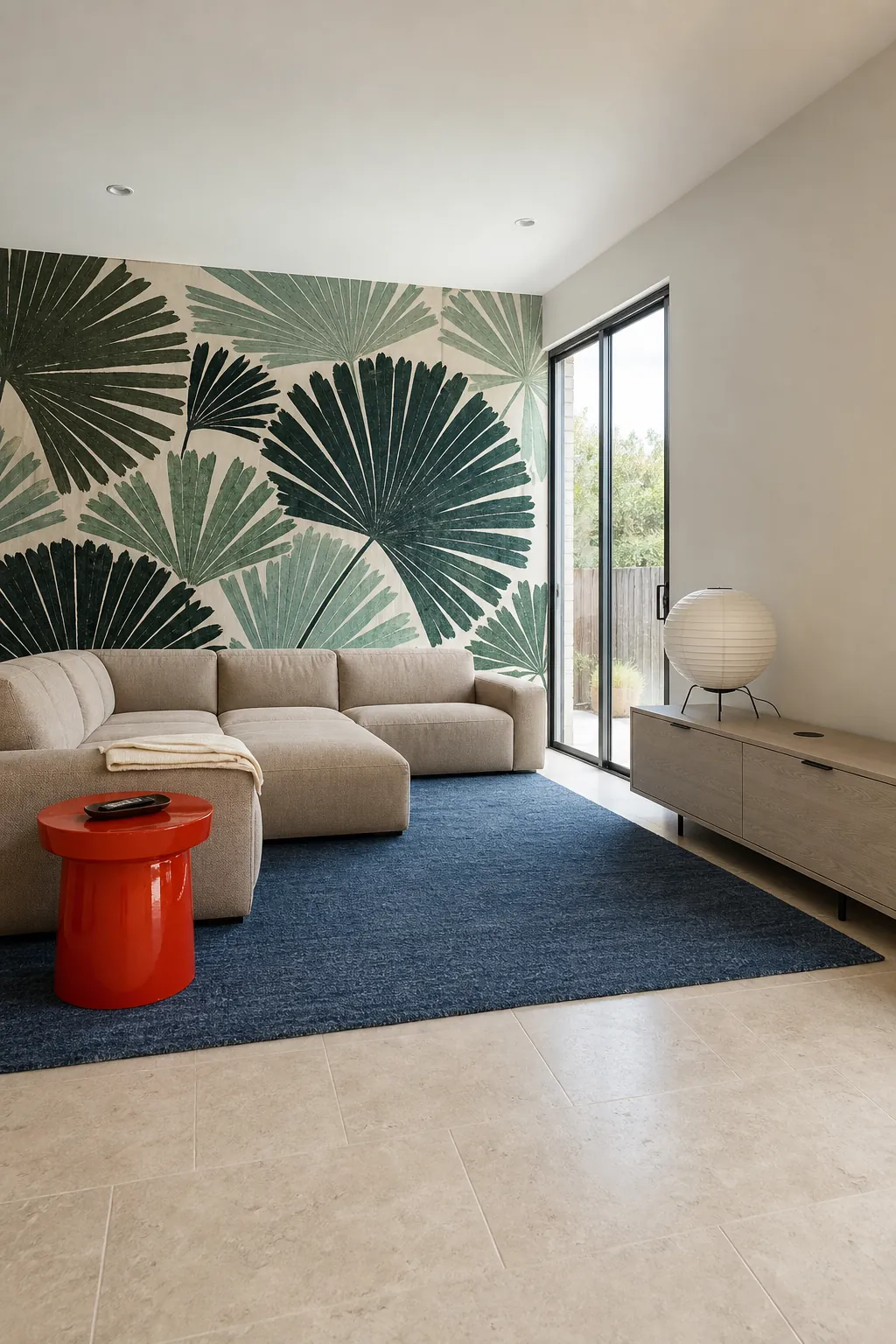

Keep large furniture shapes simple, then add texture instead of another graphic print. Bouclé, linen, cane, jute, matte ceramic, brushed metal, and visible wood grain all create interest without adding more outlines. If the room needs artwork, use it on an adjacent plain wall rather than layering several frames over the strongest palm section.
This does not mean the room must become neutral. A glossy cobalt stool, lacquer-red side table, striped cushion, or sculptural lamp can sit beautifully with a palm tree mural wallpaper. Choose one object with enough presence to answer the wall, then stop before every corner tries to become a focal point.
Test the whole decision, not just the print
Before committing, bring the mural sample into contact with the real room: place it above the skirting, beside the curtain, behind the sofa fabric, and next to the floor. Photograph the combination in the same direction you normally see the wall. The camera may reveal a clashing undertone or weak contrast that your eye has been compensating for.
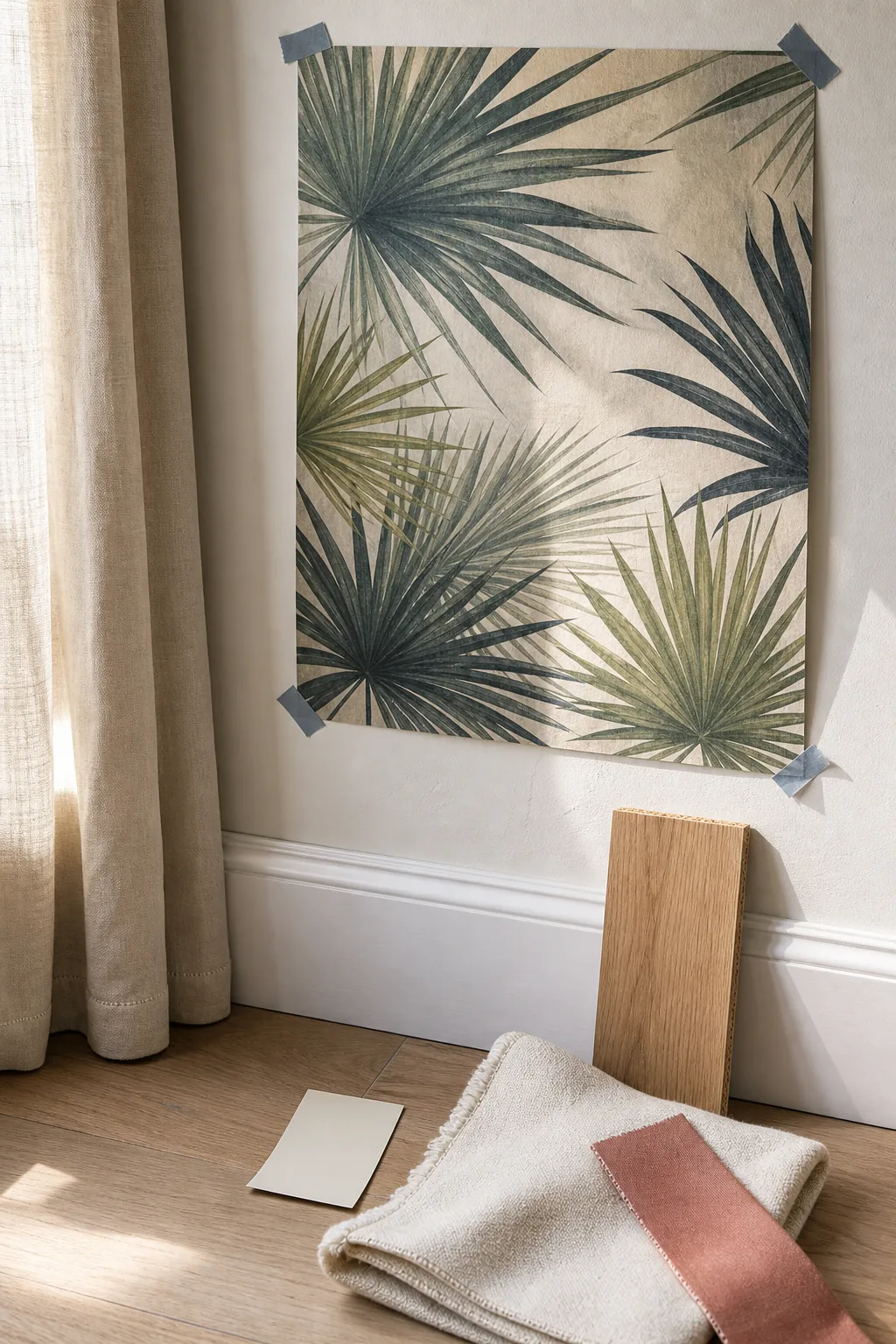

Confirm the final wall measurements, mural crop, panel order, material type, adhesive method, surface preparation, and trimming allowance with the manufacturer. Smooth, properly prepared walls matter because strong daylight can rake across the surface and reveal bumps or lifting seams. If the wall receives prolonged heat or sun, verify that the chosen product is suitable for that exact location.
A bright room already has the light. What it needs is a stronger composition. Choose palms with a direction that improves the architecture, a green that survives the room’s changing exposure, and enough contrast to wake up pale finishes. Then give the mural calm edges and a few precise color echoes. That is how a leaf mural adds energy without adding chaos.