Coastal Dune Wallpaper Murals for Neutral Living Spaces
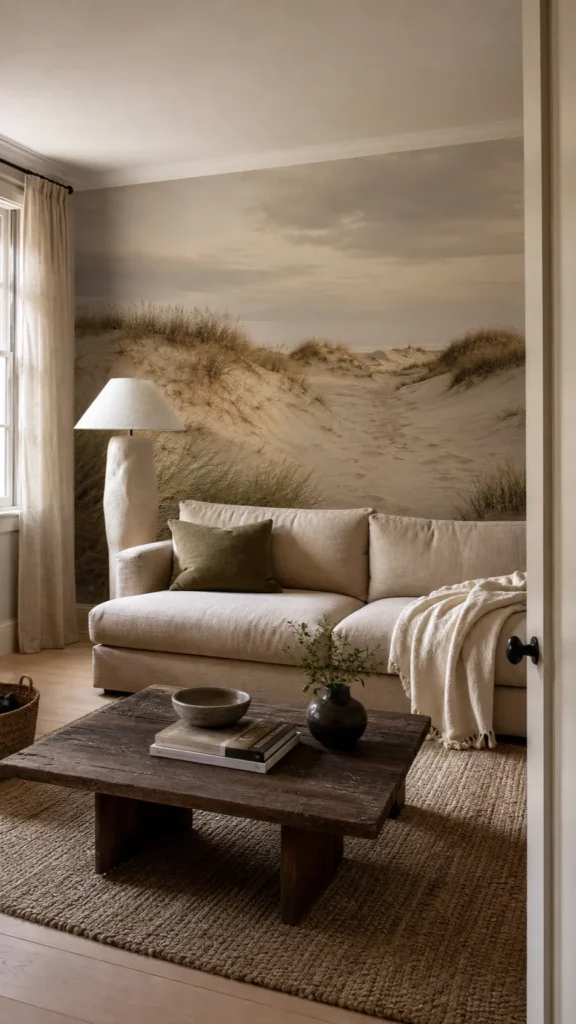
A neutral living room can be restful and still feel unfinished. When the sofa, rug, paint, and curtains all sit in the same beige middle tone, nothing gives the eye a destination. A coastal dune wallpaper mural solves that problem without forcing bright color into a room that was meant to feel quiet. The long horizon adds distance; dune grass adds fine texture; and shadowed sand introduces contrast that plain greige paint cannot provide.
The important distinction is between neutral and flat. In homeowner design discussions, “too beige” rooms are repeatedly improved with the same ingredients: texture, darker grounding notes, natural wood, and a stronger focal point. A dune mural can supply the focal point, but it should not carry the entire room alone. The most convincing spaces let the mural establish a landscape, then use furniture and textiles to translate that landscape into a comfortable place to live.
Choose dunes with depth, not empty beige
Look for a dune scene with at least three readable distances: foreground grass or rippled sand, a middle dune ridge, and a pale horizon or sky. Those layers make a wall appear to recede. A low-contrast image can still have depth if its shadows move from warm taupe to soft grey and its highlights stop short of pure white. When every part of the print is the same sandy value, the mural behaves like oversized paint rather than a view.
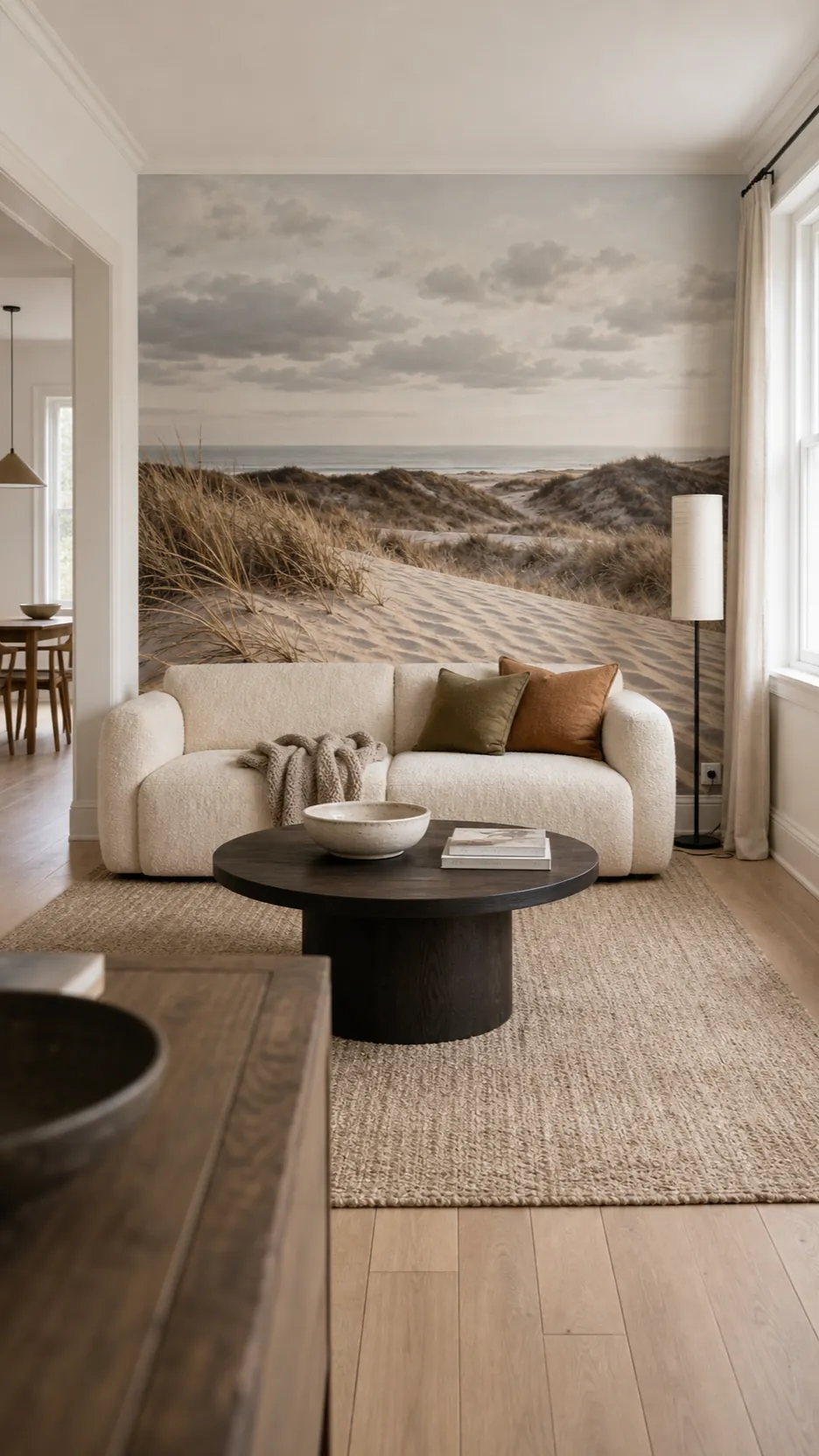

The best neutral mural contains contrast you can feel before you notice it. Wind-bent grass, a shaded dune face, cloud variation, and an off-center path all create visual movement without adding loud color. For a more minimalist room, choose broad dune shapes and sparse grass. For a cottage or relaxed family room, a closer view with denser grasses can support chunkier woven textures and older timber.
Order a material sample as well as an image proof. A matte surface usually reinforces the powdery quality of sand, while a noticeable sheen can make pale areas flash under lamps. View the sample vertically on the intended wall through a full day. Coastal glare, shaded windows, and warm evening bulbs can make the same beige print appear cool grey, cream, or unexpectedly yellow.
Give the horizon an uninterrupted wall
A neutral coastal wall mural works best when its horizon can travel. The wall behind a low sofa is a natural candidate because the furniture creates a foreground for the landscape. An open wall opposite the main seating can be even more immersive. Avoid squeezing the key dune ridge between a tall bookcase and a doorway or running the horizon directly through a television.
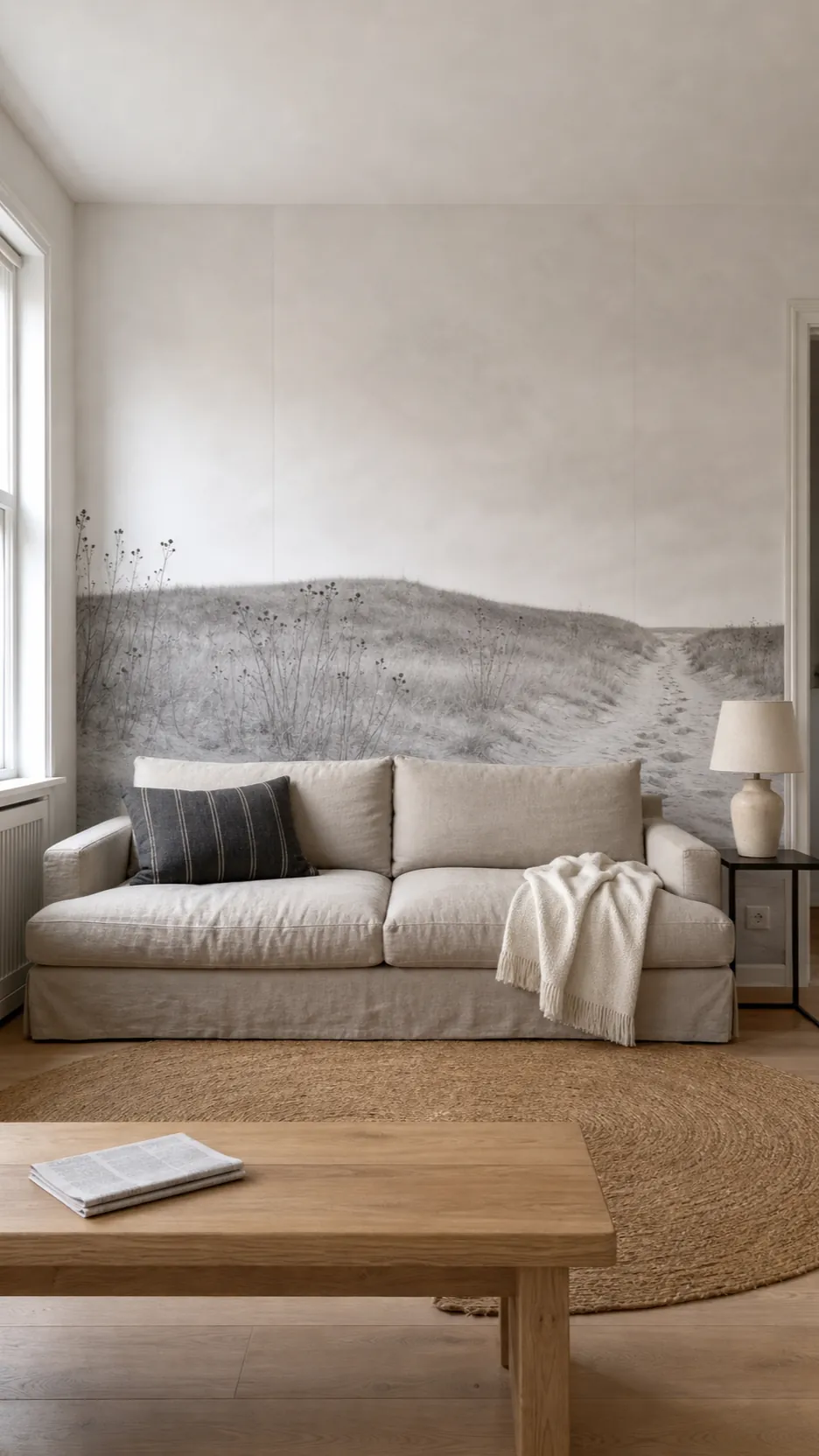

Map the image to the furniture plan before ordering. The main ridge should remain visible above seated head height, and the most detailed grass should not vanish behind the sofa. Olive et Oriel recommends testing mural tones in the living room’s changing light and planning the image around permanent interruptions. That is especially important for a pale landscape, where one badly placed seam or cropped focal point is more visible than expected.
Measure the wall at several points because ceilings and corners are rarely perfectly square. Follow the supplier’s allowance for trimming, and ask for a scaled proof showing the final crop. Do not center the composition automatically. An off-center footpath or grass cluster can balance a chaise, sideboard, or window more naturally than a symmetrical dune placed behind the middle cushion.
Build tonal contrast from sand to driftwood
A successful beige beach wall mural should not lead to ten more identical beiges. Pull a light value, a middle value, and a dark value from the print. The light might appear in linen curtains and a plaster lamp. The middle value can guide the rug and upholstery. The dark value—weathered brown, charcoal, or muted olive—should ground small but important elements such as a table base, ceramic vessel, or cushion stripe.
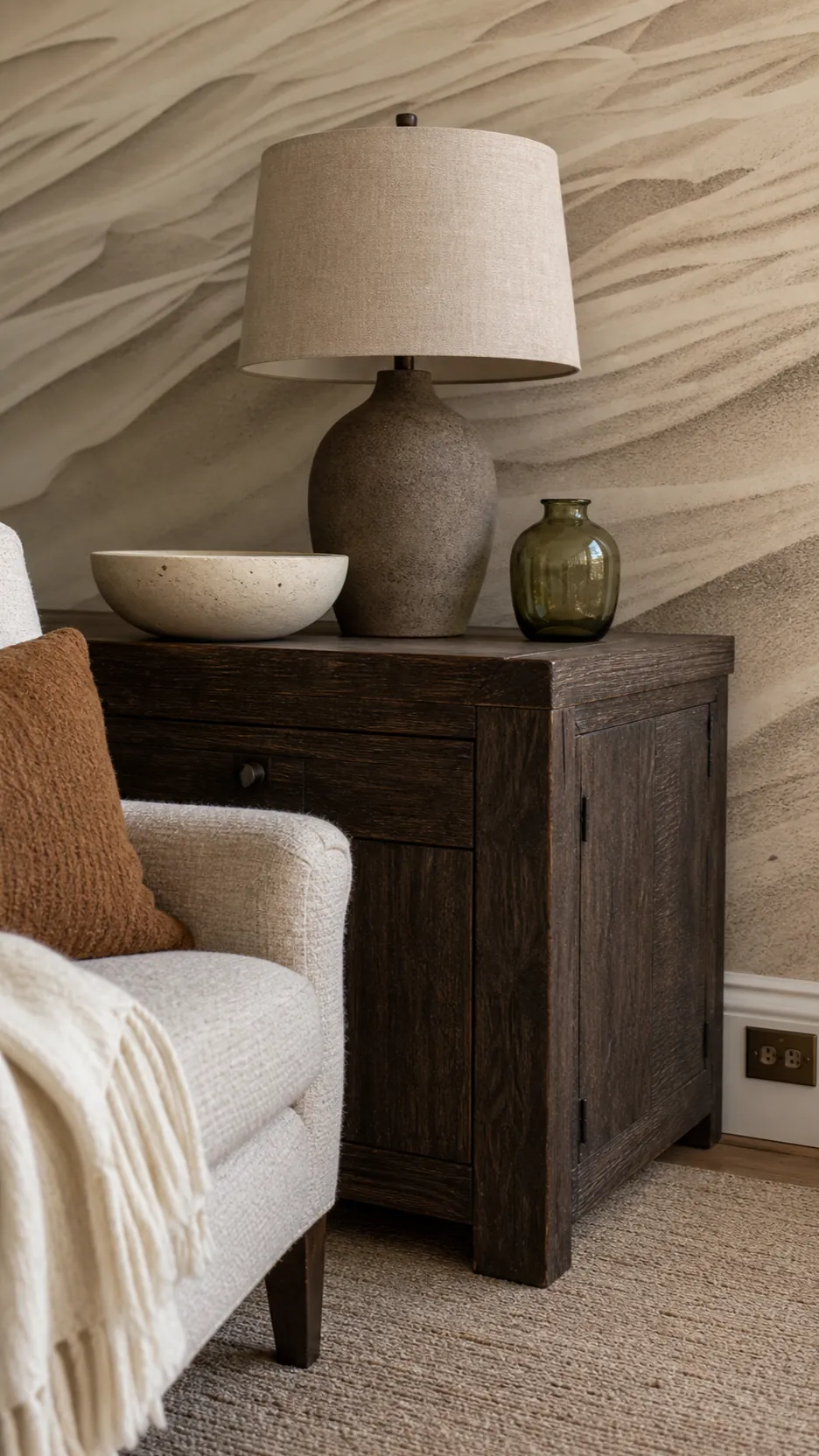

Black can work in a coastal room when it appears as a thin line rather than a heavy block. A bronze-black floor lamp, narrow metal side table, or dark picture-free shelf gives pale upholstery a clear edge. Green is another useful neutral: marram-grass olive or dried-sage tones connect directly to the dunes without reading as a decorative “pop of color.”
Keep undertones compatible. Pink-beige upholstery beside a green-grey mural can look accidental, while warm oat, mushroom, and limestone usually bridge sand and cloudy sky. Place samples together at sofa height and at the darkest time of day. If the room becomes muddy at night, increase value contrast with darker wood or charcoal rather than adding more cream.
Make texture do the work that color is not doing
Neutral rooms depend on surface change. Pair a sand dune mural wallpaper with washed linen, nubby wool, open-grain oak, matte clay, woven jute, and one smoother counterpoint such as honed stone or aged metal. These materials catch light differently, so a limited palette gains depth as the day moves across it.
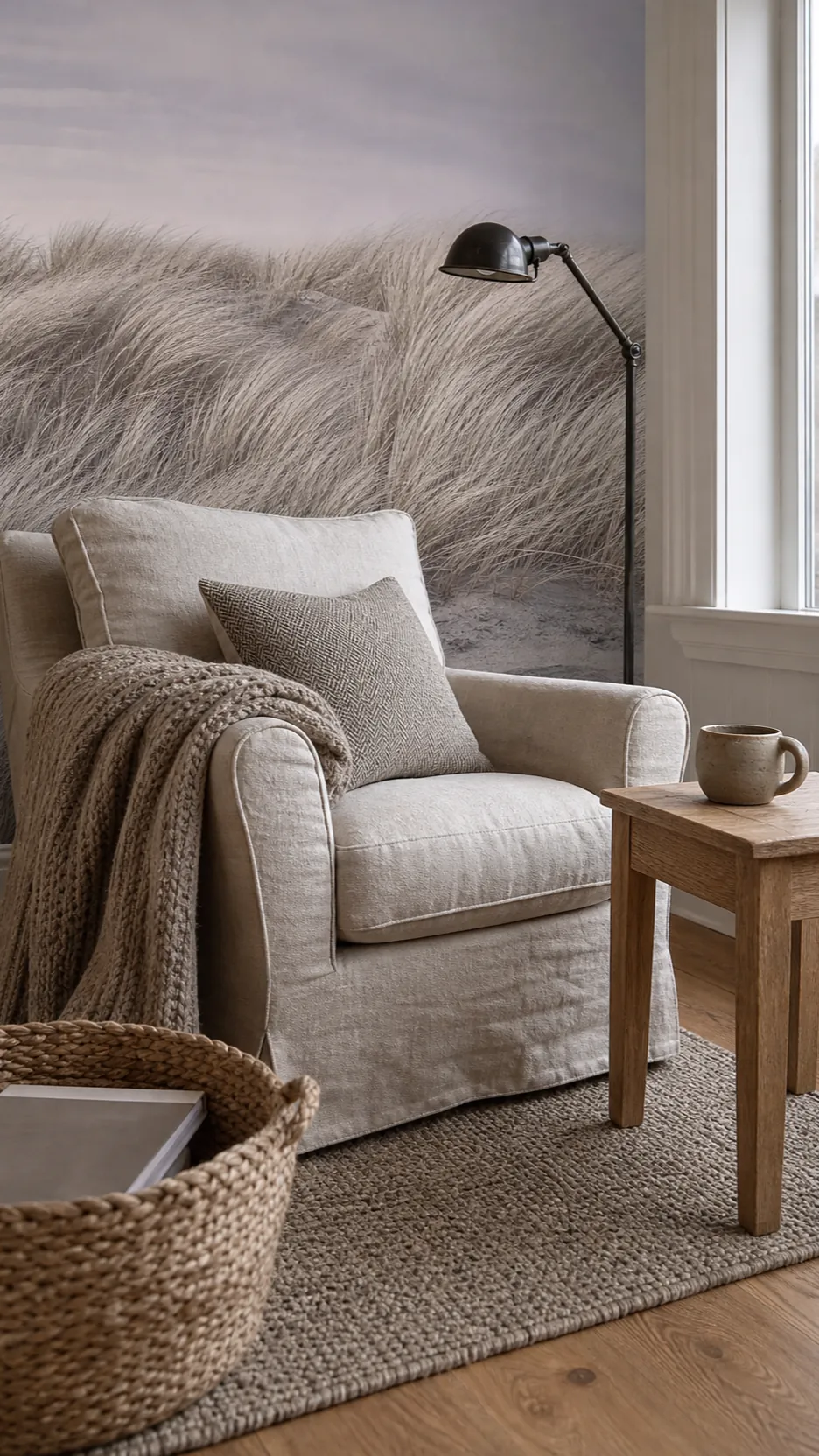

Vary the scale of texture. Fine mural grass can sit behind a broad linen weave; a deep wool rug can contrast with a smooth plaster table; a tightly woven throw can temper a rough basket. If every surface is chunky and rustic, the room becomes visually noisy. If every surface is smooth, it starts to resemble a property-staging image.
Use coastal materials, not coastal souvenirs. You do not need shells, oars, rope knots, or signs that announce the beach. The dune image is already literal. Let bleached wood, relaxed fabric, woven fibers, and hand-thrown ceramics create the sensory connection. The result feels collected and calm rather than themed.
Keep furniture low, grounded, and away from the wall
A landscape needs foreground. Pulling the sofa a few inches away from the mural wall creates a shadow line that separates furniture from image. Low backs preserve more of the dune ridge, while visible legs keep the room airy. A very dark, overstuffed sofa can still work, but it will create a stronger, moodier coastal direction than a low oatmeal linen design.
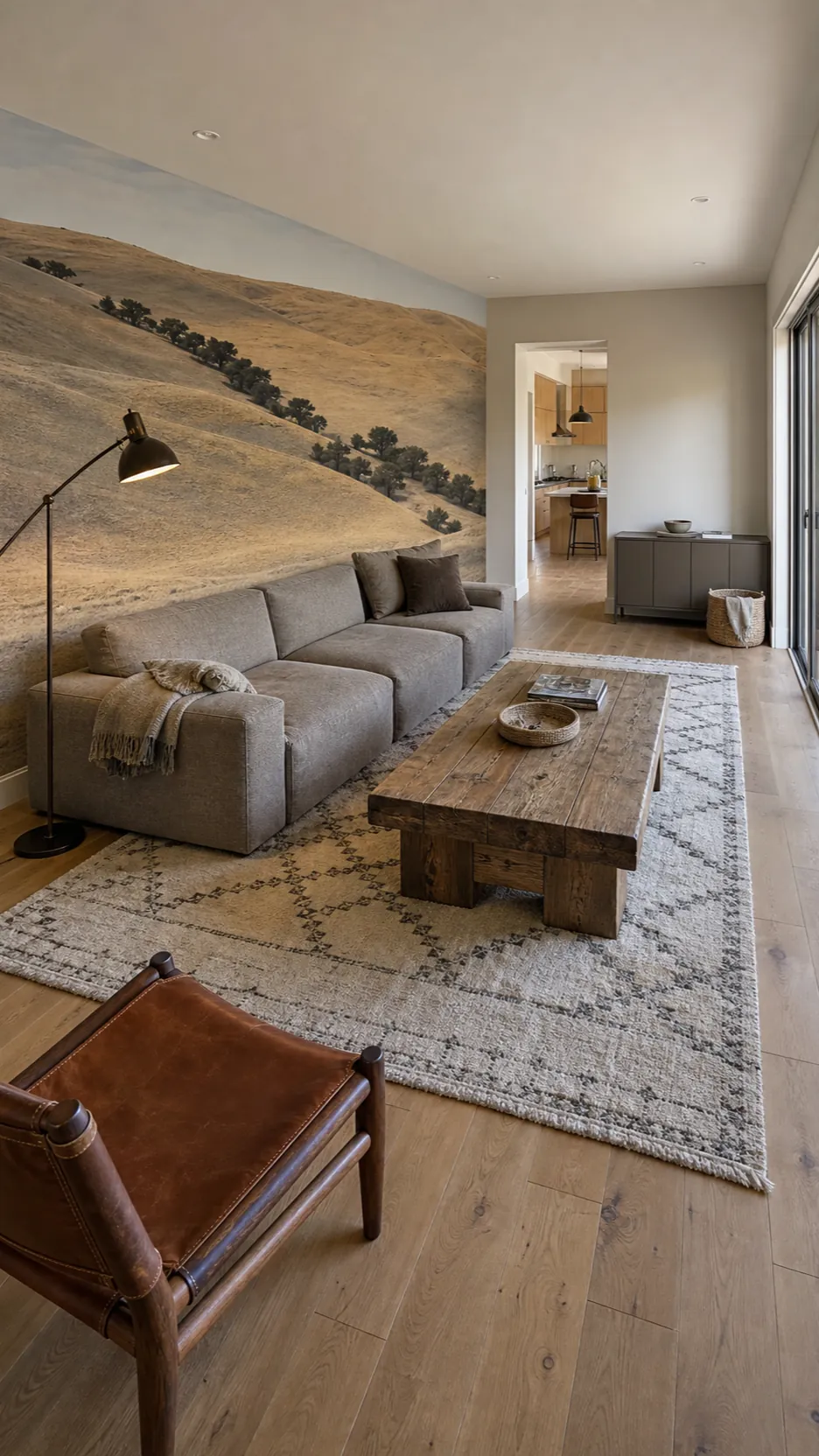

Do not push every piece to the perimeter. Reddit design feedback on neutral rooms often focuses as much on layout as color: furniture lined against walls can make even a large room feel stiff and simulated. Float a chair toward the conversation area, allow a side table to overlap the mural visually, and leave one open path that echoes the direction of the dune scene.
Choose fewer, larger forms. One substantial timber coffee table is more grounding than several tiny pale tables. A broad floor lamp balances a tall grass cluster. Closed storage prevents everyday electronics and paperwork from breaking the horizon. The room should support reading, conversation, children, pets, and television if needed; neutral design feels better when it is organized around real use.
Tune the mural to daylight and evening lamps
Daylight makes a coastal mural for a living room feel expansive, but it can also erase pale detail. In a bright south- or west-facing room, choose a print with stronger grass shadows and a definite dune contour. In a shaded room, avoid a scene whose sky and sand both sit in the darkest taupe range. The goal is readable depth without harsh contrast.
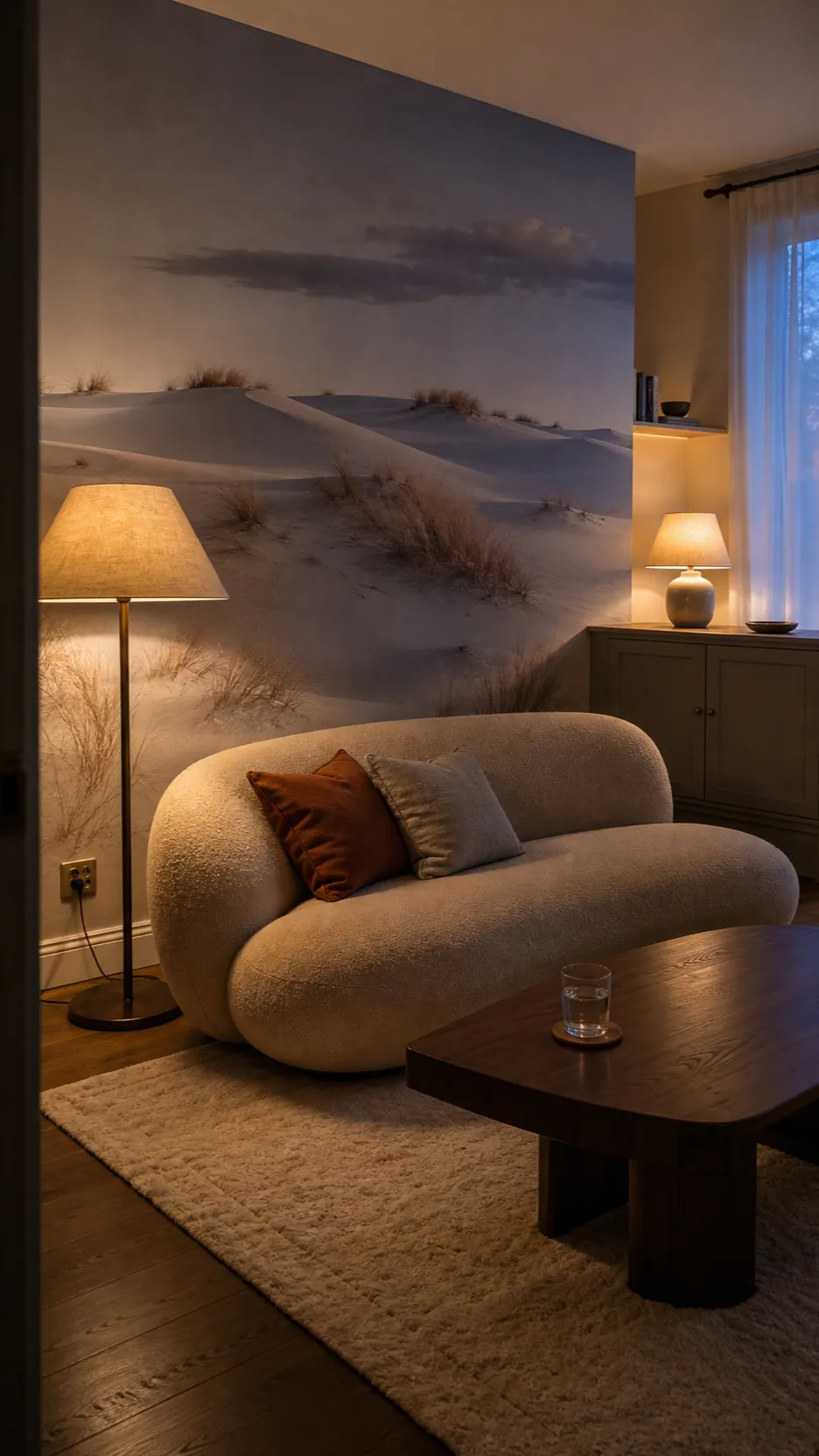

At night, use several low sources rather than one bright ceiling fixture. A shaded floor lamp beside the sofa, a table lamp across the room, and optional indirect shelf light preserve the mural’s layers. Keep bulbs reasonably consistent so sand does not turn orange on one side and grey on the other. Position lamps far enough from the wall to avoid hard cones of light that expose panel seams.
Finally, check the wall surface itself. Repair cracks, smooth texture, prime as the manufacturer directs, and dry-fit the panel sequence before paste or backing touches the wall. A subtle coastal wallpaper rewards precision because its horizon makes alignment visible. When the crop, texture, layout, and light all work together, the mural does not make the room “more beige.” It gives every neutral already in the room a reason to be there.