Soft Cloud Wallpaper Murals for Nurseries and Meditation Rooms
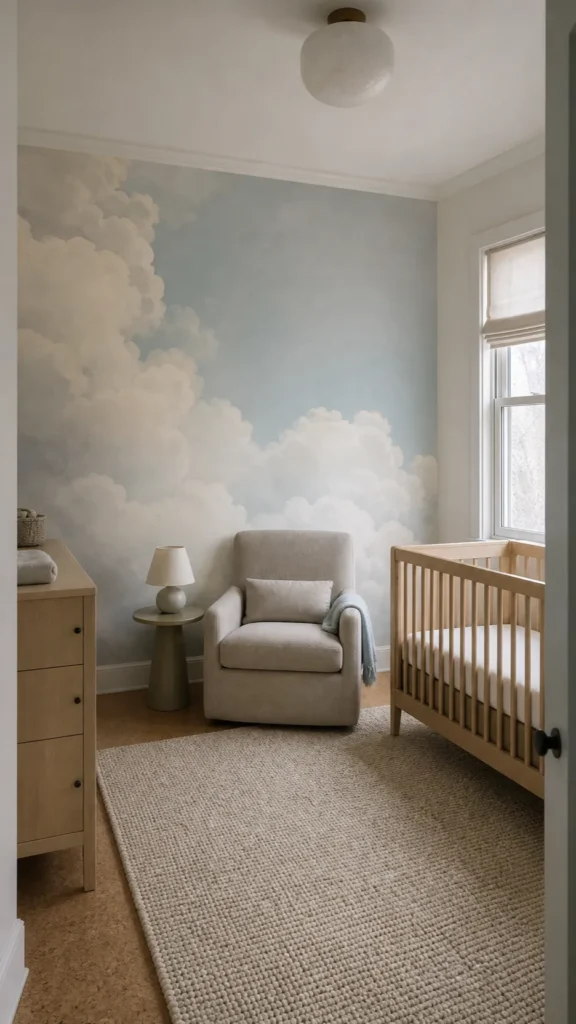
A cloud mural can make a room feel open without making it feel empty. That is why the same soft sky imagery works in two spaces with very different routines: a nursery built around care and sleep, and a meditation room built around stillness and attention. The successful versions are not the busiest or the most obviously “dreamy.” They use low contrast, generous open space, and a restrained color temperature.
The goal is not to cover a wall with as many clouds as possible. It is to choose a cloudscape whose scale, crop, and material support the way the room is actually used. Soft edges can expand a small room, but a high-contrast storm scene can feel heavy. Pale blue can look fresh in daylight, but gray under a weak bulb. Start with the room, then choose the sky.
Begin With Low Contrast and Slow Movement
The calmest cloud wallpaper murals have gradual transitions rather than hard outlines. Look for broad, feathered forms, plenty of visible sky, and a narrow value range. The cloud edges can still be detailed, but they should not create a repeated polka-dot rhythm across the wall.
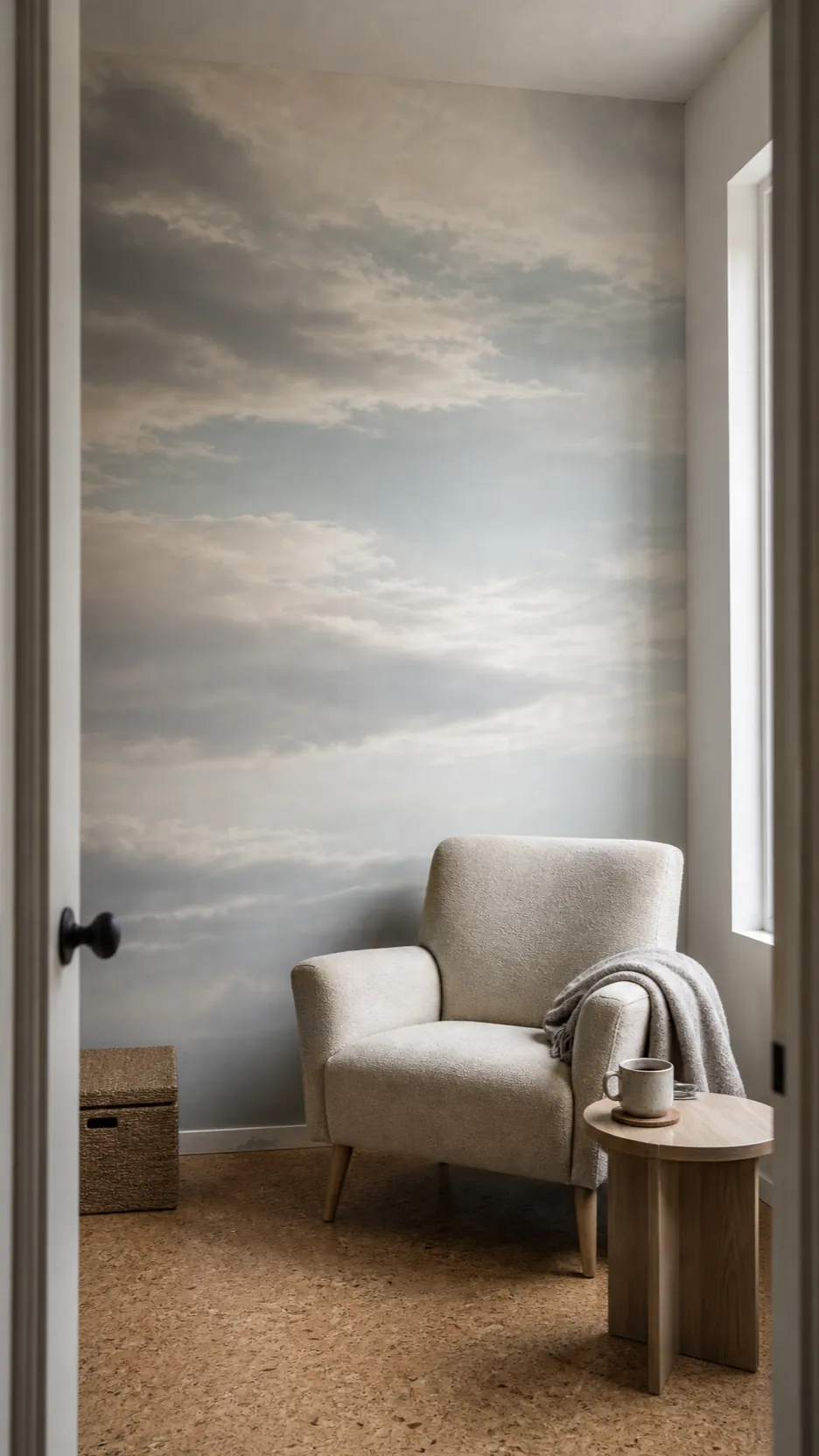

Stand back from the sample and squint. If the mural breaks into strong dark and light patches, it may dominate a sleep or meditation space. If it reads as one gentle field with a few soft focal areas, furniture and everyday objects can sit in front of it without visual conflict. Calm comes from controlled movement, not from removing all detail.
Avoid making the rest of the room equally cloud-shaped. Cloud lamps, cloud rugs, star cushions, moon decals, and balloon accessories can quickly turn one atmospheric idea into a theme. Let the mural carry the sky reference, then use simple timber, linen, wool, or woven storage to bring the room back to earth.
Choose a Nursery Cloudscape That Can Grow Up
For a nursery, choose cloud forms that feel gentle but not baby-specific. An abstract morning sky, pale layered mist, or softly painted cumulus field can work beside a crib now and later behind a reading chair or single bed. Designs built around cartoon faces or dense tiny icons may have a shorter life.
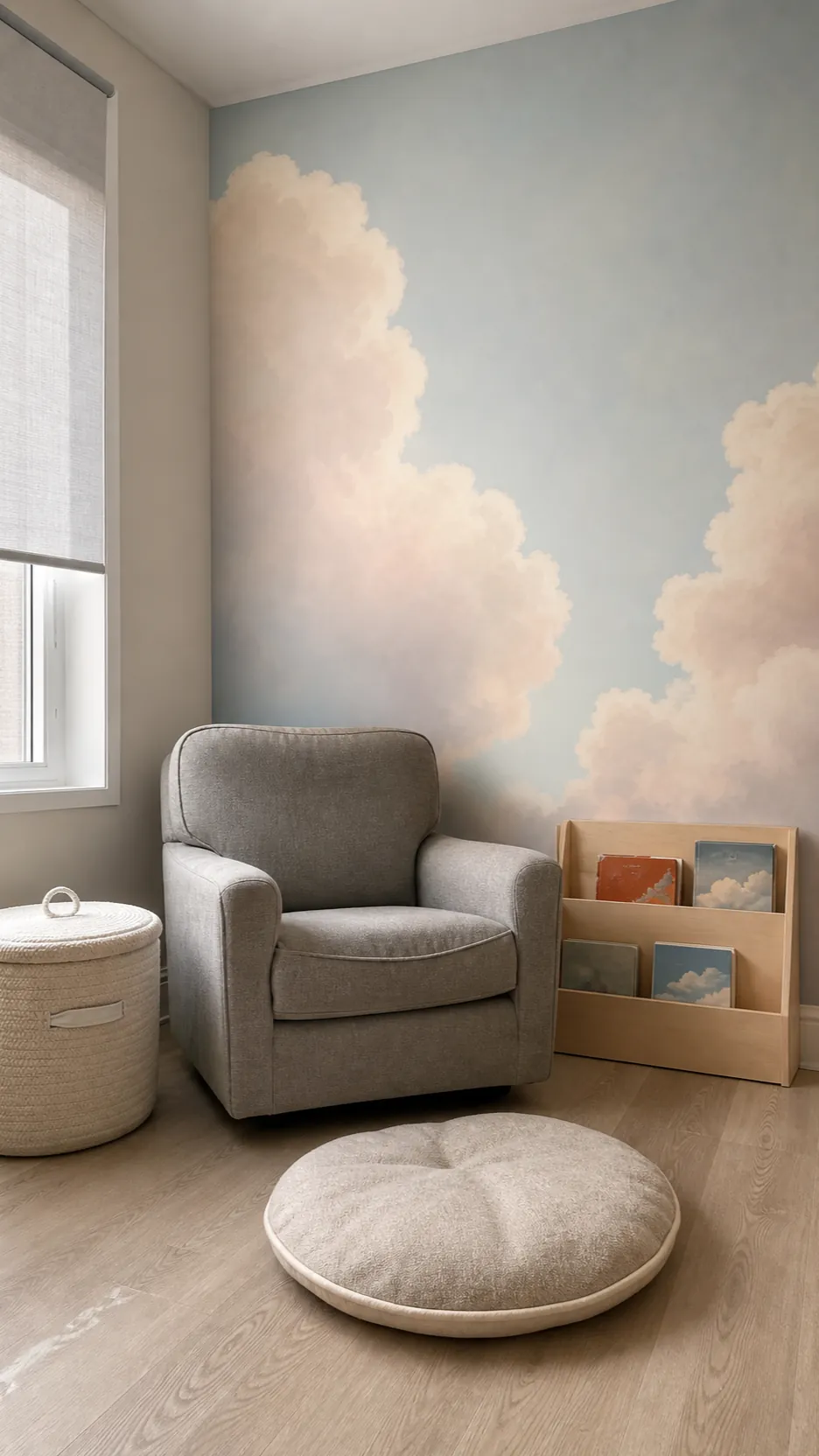

Scale matters more than adding playful motifs. One or two oversized cloud banks can feel quieter than dozens of small repeated clouds. Keep the clearest area near the primary sightline from the doorway, feeding chair, or floor play space. This gives the eye a place to rest while the lower part of the room handles storage and daily activity.
Safety and material choice belong in the design decision. Follow the crib manufacturer’s placement guidance, keep cords and loose decor out of reach, and do not rely on a lifting peel-and-stick edge near the sleep space. Check the mural maker’s material, ink, adhesive, fire, and indoor-use information rather than assuming every wallpaper is identical.
Give a Meditation Room One Clear Horizon
A meditation room needs less visual storytelling than a nursery. Choose a peaceful wallpaper mural with one broad direction: clouds opening upward, mist moving horizontally, or pale layers receding into distance. A strong central sunburst, dramatic storm edge, or sharply angled cloud can become the thing attention repeatedly catches on.
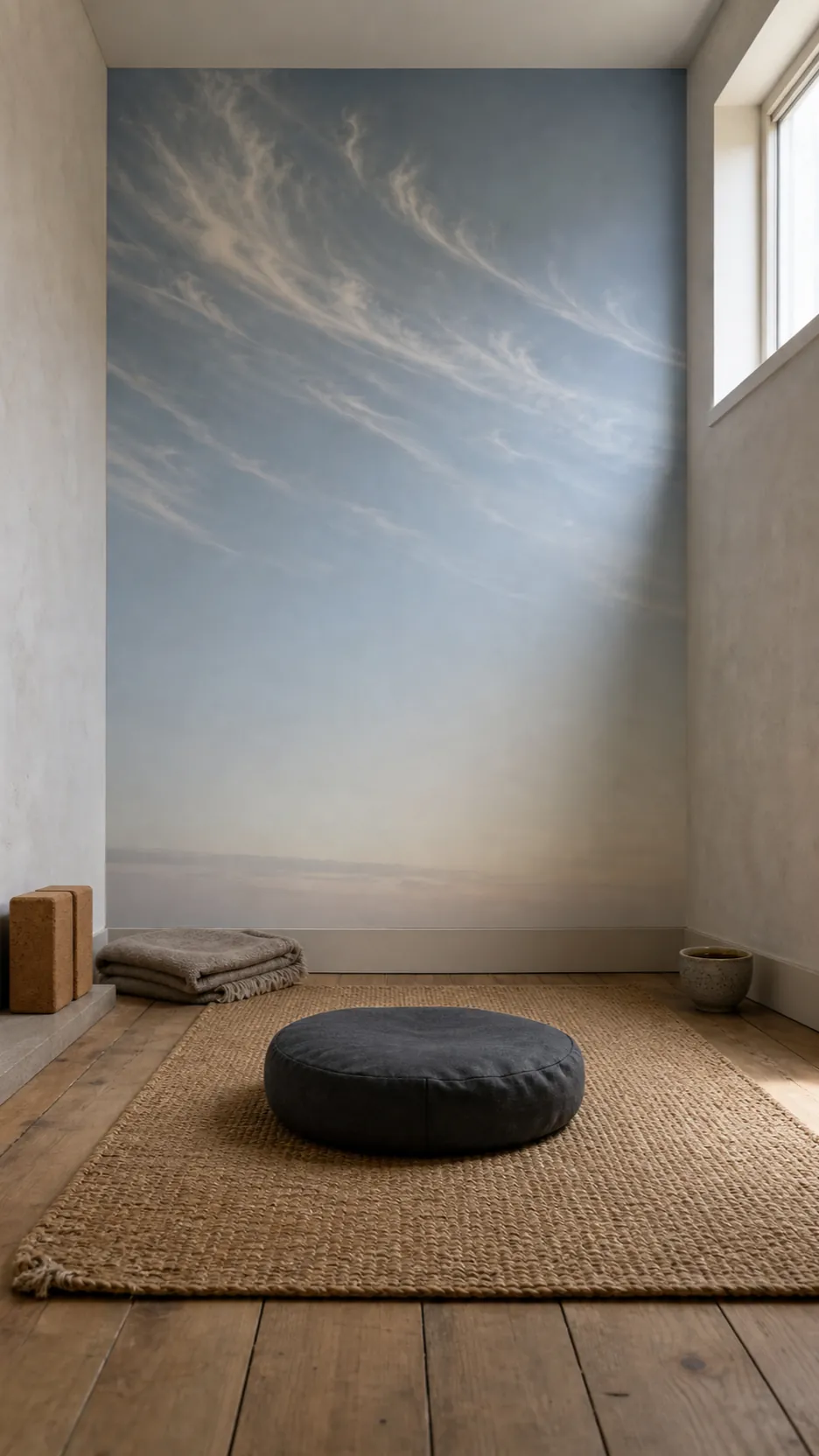

Place the quietest portion of the image at seated eye level. If the wall is behind you, the mural can be more expressive because it shapes the room rather than the gaze. If you face it, favor an open center and move any denser cloud mass toward an edge. The crop should support the practice position, not merely center the artwork on the wall.
Keep the floor arrangement spare but functional: a supportive cushion, a mat, one folded blanket, and storage that closes. Natural textures prevent the sky mural from feeling weightless or screen-like. A woven mat, cork block, clay vessel, or pale timber shelf gives the body a visual anchor.
Tune the Sky to the Room’s Natural Light
Cloud murals change dramatically with orientation. In a bright south- or west-facing room, a warm beige, blush-gray, or muted blue cloudscape can hold its softness. In a dim north-facing room, a design with too much gray may become heavy, especially once furniture blocks the lower wall.
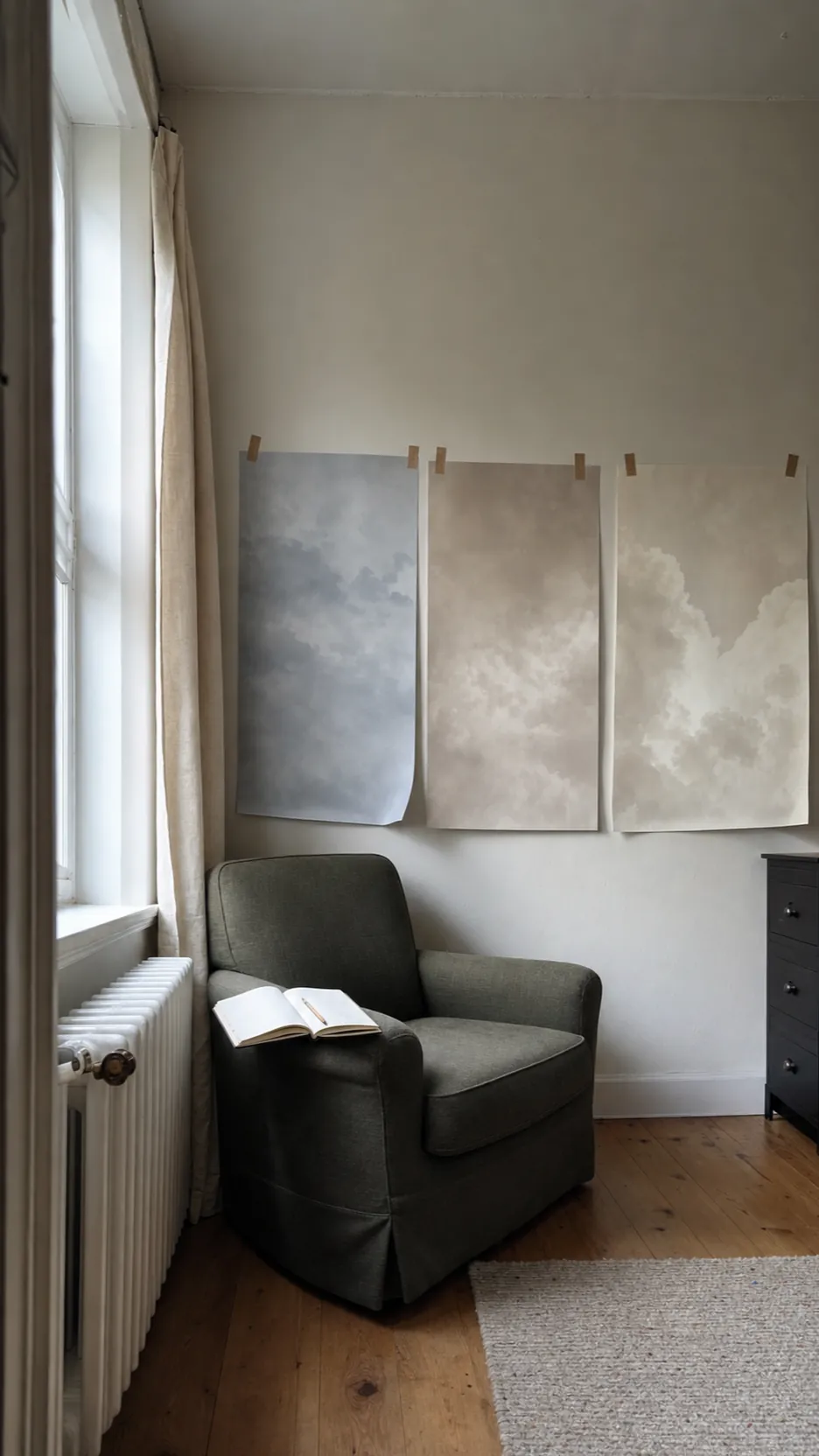

Order a physical sample and move it around the wall. Check it beside the floor, largest furniture piece, and window covering. The pale part of the print should still be distinguishable from the ceiling and trim, while the darkest cloud should not pull the entire room into shadow.
Use one color from the mural elsewhere, but change the texture or value. A misty blue-gray cloud might reappear as a deeper wool cushion; a warm cream sky might connect to a lighter linen curtain. Exact repetition can make the room look packaged. A related shade makes it feel assembled over time.
Measure, Crop, and Prepare Before Installation
Measure the wall in several places because ceilings and corners are not always perfectly square. Record the greatest width and height, then follow the supplier’s allowance guidance. Mark windows, doors, slopes, outlets, radiators, and the height of permanent furniture. Ask for a crop proof using those exact proportions.
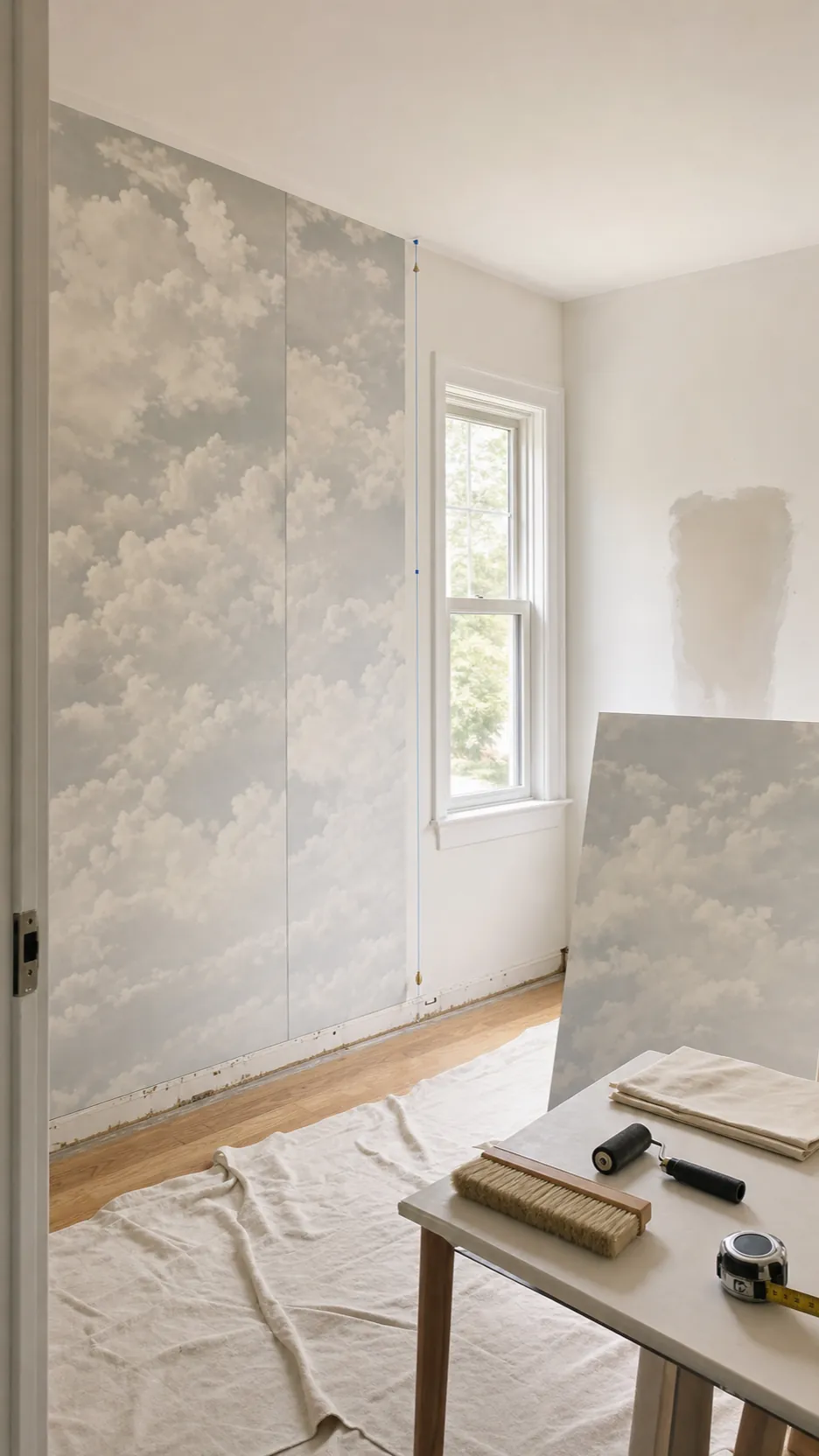

Clouds look forgiving, but a vertical seam through a small isolated cloud can be more obvious than a seam through open sky. Review panel positions as well as the overall crop. Repair holes and ridges, clean the wall, let new paint cure as directed, and use the preparation and hanging method specified for the chosen material.
Removable does not mean risk-free on every surface. Adhesion and removal depend on paint condition, texture, humidity, installation, and the product itself. Test a sample in an inconspicuous area and do not cover an unstable wall. If a panel lifts, bubbles, or falls near a crib or active floor zone, address it immediately rather than treating it as a cosmetic flaw.
Finish the Room With Grounded, Quiet Details
Once the mural is installed, resist filling every open area. In a nursery, closed storage, a washable rug, a comfortable chair, and a dimmable shaded lamp are more useful than a collection of themed objects. In a meditation room, one mat, supportive cushion, folded blanket, and a stable low shelf can be enough.
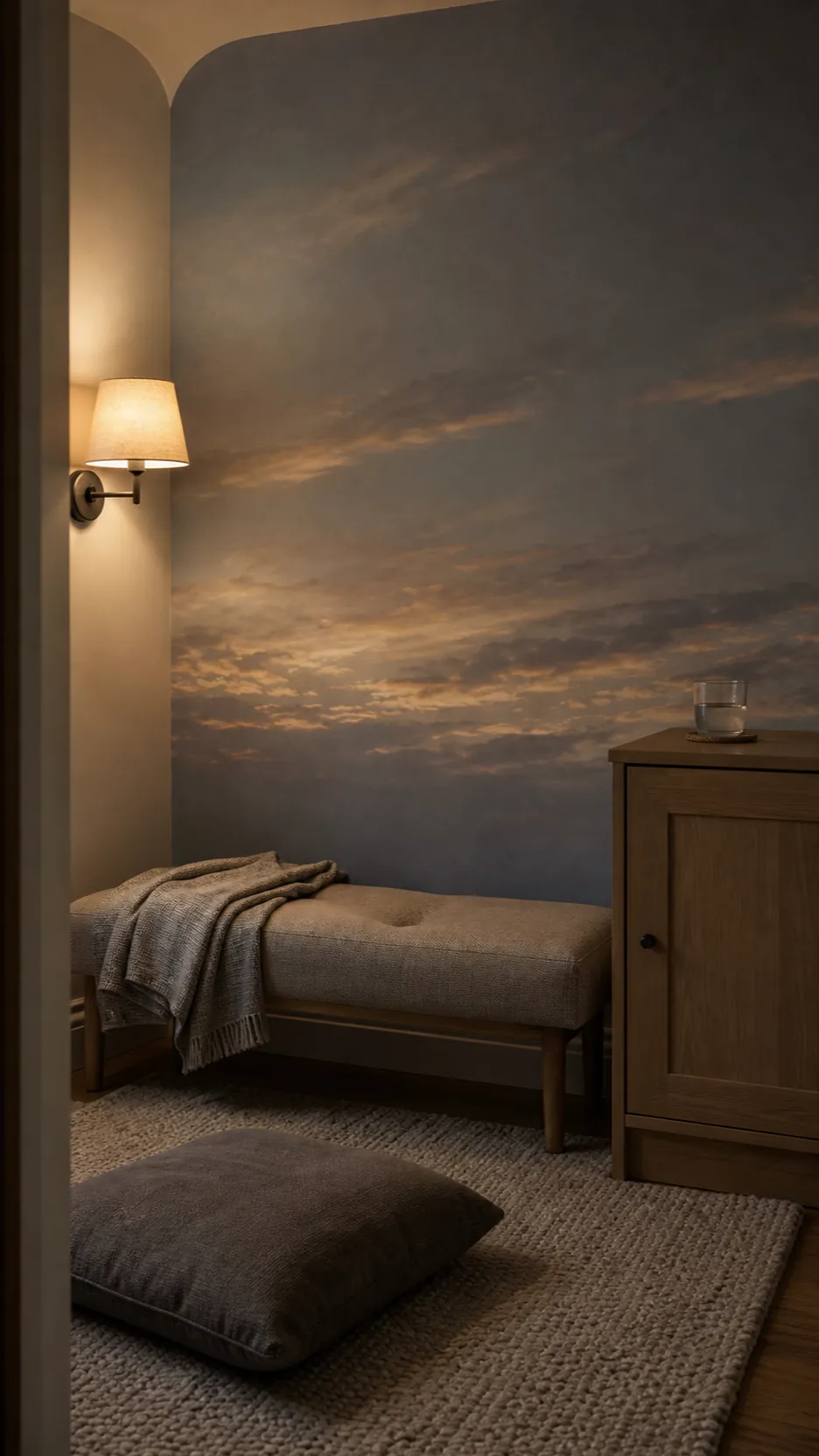

Use lamps that reveal the mural without washing it in orange or creating a bright hotspot. Light aimed across the wall can emphasize seams, so place and dim lamps while viewing the mural from the room’s main seated position. A matte surface generally supports a softer reading than a highly reflective finish.
The best soft cloud wallpaper mural does not demand attention every time you enter. It changes the room’s sense of space, gives daylight something gentle to move across, and then recedes behind the routines that matter. That quiet support is what allows the same sky to feel right above early nursery mornings and beside a few still minutes at the end of the day.